12012 stories
·
23 followers

A Kennedy Center Musician on What It’s Like There Now

1 Comment and 2 Shares

Photograph by Evy Mages.

On a blustery evening in October, Daniel Foster sat onstage at the Kennedy Center, viola in his lap. The National Symphony Orchestra was about to play “Don Juan,” an 1889 tone poem by Richard Strauss about a young libertine in search of the ideal woman. The opening is fiendishly tricky for viola. It has a fast and technical harmonic line that’s musically demanding and strange. Thirty years ago, in his audition to be the NSO’s principal violist, Foster played that excerpt. He won the job.

Foster loves playing Strauss. He loves the “liquid clarinet and the heroic French horn,” the way Strauss “pushes us into the whole range of the instrument,” asking for “the full gamut of moods and types of sound.” It’s fun, he says, to play music so demanding and sublime. Audiences love it, too. In his 30 years with the orchestra, Foster has performed “Don Juan” at various points, and always, the house was nearly full. But lately, crowds at the Kennedy Center have thinned. From the edge of the stage that night, he peered out past the grand, honeycombed chandelier, across the hall’s lush red upholstery, at deserted balconies and clusters of empty seats.

In February, just weeks after his inauguration, Donald Trump pledged to “make the Kennedy Center in Washington, D.C., GREAT AGAIN.” Citing drag shows and “anti-American propaganda,” he fired 18 Biden-appointed members of the board and made himself its chairman, vowing to rid the institution’s programming of anything woke. The fallout was intense. Performers canceled, employees resigned. Then the boycotts began. The Kennedy Center—home to the National Symphony Orchestra and Washington National Opera, host to an array of high-wattage touring acts—typically operates near capacity. By fall, attendance was down almost 40 percent.

As a citizen, Foster gets it: With Trump as the Kennedy Center’s chairman, he says, some people feel a “visceral thing” about seeing performances there. And he understands the desire to pin a failure on the administration, to send a message about partisan meddling in the arts. But it’s been disorienting to be caught in this maelstrom. As an orchestral violist, Foster spent his life in a notably apolitical job. Then suddenly, the chaos of federal politics infected his work

“Right now, I’m doubling down on what I’m there to do, which is what I love to do: I have music to prepare,” Foster said in November, amid a drumbeat of dire news stories about the Kennedy Center’s financial decline. “I try not to get overly big-picture about things, but the money that comes in from ticket sales is not just gravy.” It’s one of the NSO’s primary revenue streams. And if audiences continue to boycott the Kennedy Center, he’s concerned about collateral damage to the orchestra, in whose orbit he’s spent his whole life.

By the time Foster came into consciousness, he was already playing music. “I don’t have any recollection of choosing it,” he said; lessons were always just something he did. His first teacher was his father, William Foster, a violist who had joined the National Symphony in 1968. Back then, the orchestra played at Constitution Hall. Foster was a toddler in 1971 when the Kennedy Center opened and became the NSO’s permanent home.

Throughout his childhood, Foster was in and out of the Kennedy Center, intimately familiar with its cluttered green rooms and underground parking lot and labyrinthine hallways backstage. It felt special, the days when he was on vacation from school and came to his dad’s rehearsals. If he and his brother got restless, they’d sometimes roam the building’s vacant public spaces—the Hall of Nations, the Hall of States—“kind of mouths agape, looking around” at the scale and grandeur of it all.

He also heard great music. In 1977, the famed cellist Mstislav Rostropovich became the NSO’s music director. An exiled Soviet dissident, Rostropovich brought the orchestra global renown, expanding its size, recruiting preeminent guest artists, and plotting ambitious international tours. His 17-year tenure is legendary. The NSO’s musicians “live in a completely different world now than [before] Slava took the reins,” Foster’s dad told the Washington Post in 1992. The maestro was “able to instill some of [his] genius in the orchestra.”

In some ways, Foster’s path seems preordained. For generations, his family has teemed with musicians: his mother, his brother, various cousins, multiple grandparents. His maternal grandfather, a violinist, is best known for introducing the Suzuki method of music education to the United States. But Foster meant to do something else. He thought he’d study math or philosophy. He nursed a passion for sports. Then, in high school, he came to love the viola, with its throaty, earthbound sound. It suited him, sitting in the middle of the harmony, not carrying the melody but maneuvering beneath it, subtly changing a piece’s emotional mood.

“It’s kind of weird the way my life played out,” Foster recently reflected, “because I was bound and determined to set my own course, and I ended up doing the opposite.” He enrolled at Oberlin College, where his parents and grandparents had gone, and studied viola, just as his father had done. A year after graduating, he got a job in the NSO’s viola section, where he played alongside his dad. For a while, the Fosters shared a music stand onstage. They were colleagues for 25 years.

Daniel and dad William in Moscow in 1993. Photograph courtesy of Daniel Foster.

Foster’s first season with the orchestra was also Rostropovich’s last. And the very first concert he played with the NSO was not at the Kennedy Center but in Moscow’s Red Square, during the Russian constitutional crisis of 1993. The air was near freezing, but still, the concert was packed—100,000 people came, according to press coverage at the time. Among them was Boris Yeltsin, whose presidency was then under threat. The chill knocked instruments out of tune and some musicians wore fingerless gloves, but Foster recalls the concert being “completely epic.” When the orchestra played Tchaikovsky’s 1812 Overture, the bells of the Kremlin rang out.

During his 30-year career, Foster has had some transcendent moments: performing with Itzhak Perlman and Yo-Yo Ma, playing music he’s loved since he was a child. And just as his dad lived through that lustrous Rostropovich era, Foster feels that the NSO is currently approaching another peak. Music director Gianandrea Noseda, who came to Washington in 2017, has been “the perfect person at the perfect time to unleash all of our potential,” Foster said. Under Noseda, there’s been a different energy in the orchestra, its 96 members reaching for musicianship they couldn’t access before. It’s exciting to be part of. The musicians want the public to see. It’s a bitter irony, then, that just as the orchestra is reaching this artistic pinnacle, much of its audience has disappeared.

The opening theme of “Don Juan” is strident and ascending. As it echoed across the concert hall, Foster sat at the head of the violas, taut with focus, fingers flickering through a vertiginous cascade of notes. The piece meanders through moods: ominous timpani rolls, a sad morass of horns, tinkling bells, the deep bloom of harp. Toward the end, as Don Juan falls into despair, there’s a frenetic collapse, a blurred chromatic dive, the notes piling up into chaos, into stressful minor chords that precede the hero’s death. It’s a bleak ending, but still, the paltry audience cheered.

Musicians are trained to leave their problems backstage. Whatever afflicts them, they still have to focus and play. That’s what Foster’s been trying to do, but it’s tough with all the turbulence—the near-constant bad headlines about the Kennedy Center’s leadership, about a Senate investigation into its finances, about its sudden hosting of partisan events. There was the booing of JD Vance, then the alarming speculation about the opera’s potential relocation, then the multi-week disruption when FIFA took over the Kennedy Center to host its World Cup draw. Meanwhile, Foster has rehearsed and performed and tried not to worry, to varying degrees of success.

Lately, members of the orchestra have strategized about winning their audience back, but nobody quite knows what to do.

Looking out across the hall’s empty seats, he often thinks of the pandemic—of that dismal year when the orchestra couldn’t perform, when he’d drag himself into his music room to practice and think, What am I doing this for? Without people to listen, what’s the purpose? Now, after a concert, Foster can’t help but imagine those who didn’t attend—the orchestra’s regular audience, the subscribers who chose not to return—and wish that they’d come. “I think it would have value to them,” he said. “People want to feel stuff. It makes us feel alive.”

Lately, members of the orchestra have strategized about winning their audience back, but nobody quite knows what to do. For Foster, talking to people—friends, acquaintances, strangers from his neighborhood listserv—has brought a little relief. Even skeptics will listen when he speaks in more personal terms, when he explains what the boycotts have meant to him and his family: to his wife, who plays flute in the Washington National Opera, and his son, who’s a college violinist and might someday want to audition for the NSO.

Often, Foster finds himself puncturing misconceptions. One is that the administration is telling musicians what to play, which—aside from a new policy requiring the national anthem before each concert—he insists is not true. Another is that the orchestra and opera could simply play elsewhere until a new administration is sworn in. But the Kennedy Center, he explains, has the region’s only orchestra pit big enough for grand opera, and no other venue could accommodate the NSO’s busy concert schedule without canceling previously booked acts. Besides, the Kennedy Center provides the orchestra with significant financial support, so leaving would mean losing that money. And the NSO should play at the Kennedy Center, he believes: “We’ve been there for 54 years now. It’s our home.”

Hurting the Kennedy Center to send a political message could also mean the collapse of a 95-year-old orchestra and a 70-year-old opera.

For those who simply refuse to support an institution that’s publicly affiliated with Trump, Foster’s arguments won’t make much difference. Still, he wants them to understand that hurting the Kennedy Center to send a political message could also mean the collapse of a 95-year-old orchestra and a 70-year-old opera, a diminishment of the city’s arts programming, and ripple effects through the community—on the elementary schools for which the NSO regularly gives free concerts, for example, or the soup kitchen near the Kennedy Center where opera musicians sometimes play during meals. “It’s not appropriate for me to tell people what they should and shouldn’t do,” he said. But he does wonder, if all that were lost, whether it would have been worth it to the public in the end, whether the potential consequences of the boycott are proportionate to its aim of perhaps slightly embarrassing Trump.

In discussing the orchestra’s uncertain future, Foster recalled a time during the pandemic when he worried that audiences would never return—that they’d get used to hearing music on a stereo and forget the value of venturing out, in person, to watch. But people did come back, he said, because when musicians play for an audience, something ineffable happens. He described an outdoor performance at Wolf Trap—the first concert he played post-pandemic where nobody was required to mask, where he could see people’s expressions in the crowd. Renée Fleming was singing. And during a few measures of rest, Foster glanced out at the audience and saw them “outside of themselves,” having a collective experience of beauty. “You could see it on their faces—they were transported,” he said. “And that’s it, right there—we feed off of that. That’s what you wish for.” As he described it, he spent about a half a minute in silence, overcome.

This article appears in the January 2025 issue of Washingtonian.

Read the whole story
freeAgent
55 minutes ago
reply
Trump plastering his name on the Kennedy Center is in extremely poor taste, but I hope people don't let Trump destroy the arts in DC so easily.
Los Angeles, CA
acdha
17 hours ago
reply
Washington, DC
Share this story
Delete

new Apple iOS update is wrecking my iPhone

1 Share
Is the latest iPhone operating system aesthetically appealing? No. But is it useful? Also no. At least I have company among the disgruntled.
Read the whole story
freeAgent
1 hour ago
reply
Los Angeles, CA
Share this story
Delete

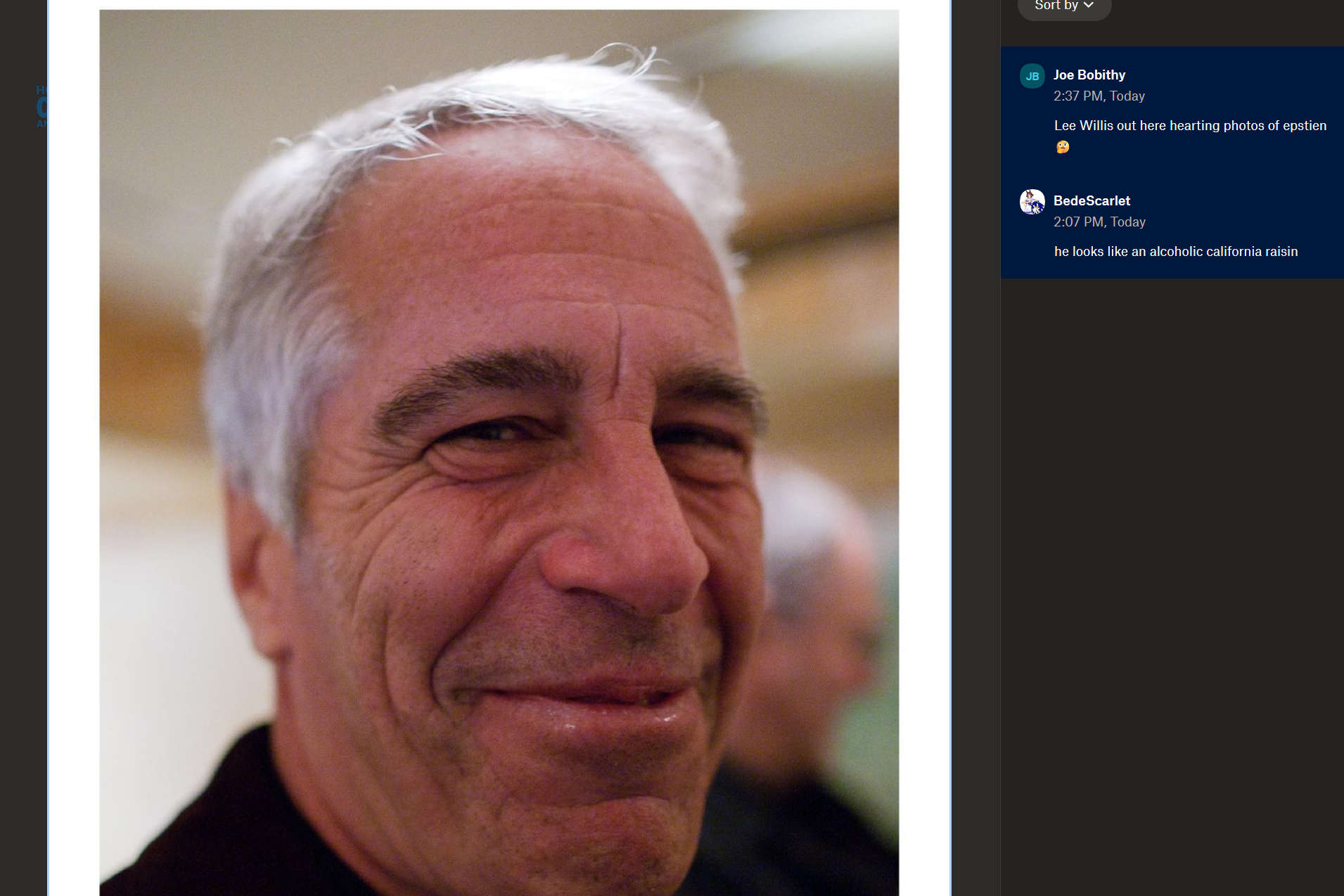
The Government Added a Comments Section to the Epstein Photo Dump

1 Share

Update: After publication of this piece, House Oversight Democrats disabled comments on the photos. The original article follows below.

Thursday afternoon House Democrats publicly released a new trove of photographs they’ve obtained from the estate of Jeffrey Epstein via Dropbox. They left the comments on so anyone who is signed into Dropbox and browsing the material can leave behind their thoughts.

Given that the investigation into Epstein is one of the most closely followed cases in the world and a subject of endless conspiracy theories, and that the committee released the trove of photographs with no context, it’s not surprising that people immediately began commenting on the photographs. 

“Really punchable face,” BedeScarlet—whose avatar is Cloud from Final Fantasy VIIsaid above a picture of New York Times columnist David Brooks. Brooks, who wrote a column about his boredom with the Epstein case in November, attended a dinner with Epstein in 2011 and appears in two photographs in this new document dump.

“Noam Chomsky,” Alya Colours (a frequent Epstein dropbox commenter) said below a photograph of the linguist talking to Epstein on a plane. Below this there is a little prompt from Dropbox asking me to “join the conversation” next to a smiley face.

In another picture, director Woody Allen is bundled up to his eyes in a heavy coat while Epstein side hugs him. “Yep, I’d know that face anywhere,” Susan Brown commented.

Among the pictures is a closeup of a prescription bottle labeled Phenazopyridine. “This is a medication used to treat pain from urinary tract infections,” Rebecca Stinton added, helpfully, in the comments.

“The fuck were they doing all that math for?” BedeScarlet said next to a picture of Epstein in front of a whiteboard covered in equations.

“Shit probably tastes like ass,” he added to a picture of Epstein cooking something in a kitchen.

There are darker and weird photographs in this collection of images that, as of this writing, do not yet have comments. There’s a pair of box springs in an unfinished room lit by the sun. There is a map of Little St James indicating where Epstein wants various buildings constructed. Bill Gates is shown in two photos standing next to women with their faces blocked out.

And then there are the Lolita pictures. A woman’s foot sits in the foreground, a worn annotated copy of Vladimir Nabokov novel Lolita in the background. “She was Lo, plain Lo, in the morning, standing four feet teen in one sock,” is written on the foot, a quote from the novel.

These photos are followed by a series of pictures of passports with the information redacted. Some are from Ukraine. There’s one from South Africa and another from the Czech Republic.

The House Democrats allowing the public to comment on these photos is funny and it’s unclear if intentional or a mistake. It’s also a continuation of the just-get-out-there approach when they have published other material, with it sometimes being in unsorted caches that readers then have to dig through. The only grand revelation in the new material is that Brooks was present at a dinner with Epstein in 2011.

“As a journalist, David Brooks regularly attends events to speak with noted and important business leaders to inform his columns, which is exactly what happened at this 2011 event. Mr. Brooks had no contact with him before or after this single attendance at a widely-attended dinner,” a Times spokesperson told Semafor’s Max Tani.

House Oversight Democrats did not immediately return 404 Media’s request for comment.


Read the whole story
freeAgent
1 hour ago
reply
Los Angeles, CA
Share this story
Delete

State regulators vote to keep utility profits high, angering customers across California

1 Comment

The California Public Utilities Commission voted 4 to 1 on Thursday to keep profits at Southern California Edison and the state's other big investor-owned utilities at a level that consumer groups say has long been inflated.

Read the whole story
freeAgent
1 hour ago
reply
Repeat after me: regulatory capture.
Los Angeles, CA
Share this story
Delete

The Fast Fashion Dilemma

1 Comment

Shoppers are filling their carts, both literally and digitally, with last-minute gifts. One tempting purchase, whether for gifting or for showing up in style at a holiday sweater party, is ultra-cheap clothing from Shein. Like many around the world, the French hunt for deals in December.

During a recent interview with journalist Thomas Mahler, I learned that fast fashion has become a political flashpoint in France, the country known for haute couture. French lawmakers are considering measures aimed at threatening the economic viability of Shein, the Chinese company that dominates ultra-cheap clothing globally. 

Millions of French consumers shop through Shein regularly. Mahler asked me: Can politicians persuade consumers to buy domestically-made clothes instead, in a country with a proud tradition in domestic fashion? My reply was that this dilemma extends beyond France. Wealthy countries do not manufacture much apparel at home. It’s cheaper to produce at scale in lower-income countries, and residents of rich nations rarely aspire to work in garment factories. 

The French government’s proposed intervention is an “eco-penalty” on fast-fashion items, a tax that could eventually add €10 per garment. The purpose is to make French-made clothing more competitive while also discouraging the environmental excesses of disposable fashion.

Fast fashion generates garbage. Trend cycles in cheap apparel last for only weeks instead of seasons. Shein adds many new items daily, while a traditional French fashion house releases only a few designs each year. Much of the clothing is so cheaply made that it’s worn only a few times before being thrown away. Even charities struggle to accept donated garments because of the flood of unwanted clothes. Discarded polyester shirts pile up in landfills at best, or pollute rivers and beaches at worst. Synthetic fibers shed microplastics. These are real externalities

France’s approach thus combines modern environmentalism with a familiar protectionism. It may be politically easier to sell a tariff when it’s framed as discouraging “wasteful” consumption rather than only protecting domestic producers.

Revealed preferences, meaning the preferences people demonstrate through their actual purchasing behavior rather than their stated ideals, show that consumers want affordability and variety. That puts them at odds with protectionist policymakers. When a Shein dress costs €15 and a French-made equivalent costs €100, even patriotic consumers face a hard trade-off. The price gap reflects not just labor costs, but supply-chain efficiencies, economies of scale, and a fundamentally different business model.

Even if these measures succeeded in reducing the amount of clothing bought from Shien, would the French people take garment manufacturing jobs that are “brought back” to France? French youth unemployment hovers above 17%, but garment work doesn’t match the aspirations of an educated workforce. In the United States, the few apparel factories that remain largely employ recent immigrants. Is trying to rebuild a mid-20th-century industrial base like trying to resurrect typewriters? Nostalgia is not an economic strategy in a technologically advancing world. Furthermore, would robots soon “take” most jobs that could be done by French people today in garment manufacturing? 

Mahler also asked me whether people could simply buy fewer clothes to help the environment. It’s an interesting question because we also see this dilemma with food in the rich world today. Calories were once expensive; now the binding constraint is waistlines, not income. Clothing has followed the same pattern. After the Multi-Fiber Arrangement ended in 2005, global textile trade boomed. For example, one Chinese city now produces more than 20 billion pairs of socks per year, which they can export at low prices. For many consumers, the price of clothes is not the main constraint on how many garments they purchase. The result has been the democratization of style and abundance.

Reasonable people can debate the appropriate policy response. A Pigouvian tax on new garments to fund recycling or reduce waste, akin to a carbon tax, is worth considering. Better labeling, such as durability ratings, could help consumers make more informed decisions on how long garments will last so they can appropriately trade off price versus quality. Cultural norms are shifting such that some consumers brag about thrift-store finds rather than new purchases, somewhat reducing the flow of new clothes to landfills. 

While addressing the excesses of cheap fashion, we should resist romanticizing the past. We should not return to a world in which only the rich could afford variety and comfort. Countries like Bangladesh and Vietnam have reduced poverty by joining global garment supply chains. Bangladesh’s GDP per capita was under $500 in 1998; today it is over $2,500. 

Fast fashion is neither a triumph nor a catastrophe. It is the outcome of solving an important problem: how to clothe billions of people affordably. The French, along with many of us around the world, now face a more pleasant question: how much is enough once basic scarcity has been conquered?

Someone from 1850, wearing his one patched coat, would be astonished to learn that we are debating whether people buy too many clothes. That we have the luxury to ask is evidence that, despite its problems, the system has delivered something extraordinary.

(4 COMMENTS)
Read the whole story
freeAgent
1 hour ago
reply
We should try to educate people that buying disposable shit is bad for the environment and your soul. Also, a single city in China produces 20 billion pairs of socks per year!? That's not 20 billion socks, it's 20 billion *pairs* of socks. That's almost 2.5 pairs of socks per person per year coming from a single city in China! How many new pairs of socks do you go through each year?
Los Angeles, CA
Share this story
Delete

The U.S. Is Stealing From Millennials and Gen Z To Make Boomers Even Richer

1 Comment
Two Baby Boomers on a beach, with Medicare and Social Security cards behind them | Illustration: Eddie Marshall | Nano Banana

For years, pointing out the obvious was considered impolite: America's biggest, most distortionary transfer of wealth does not flow from elites to the working class. Nor does it show up as corporate welfare. It flows from the relatively young and poor to the relatively old and wealthy. It's the defining injustice of our fiscal regime, the largest driver of our government debt, and the quiet engine behind the malaise of Millennials and Gen Z.

More than a decade ago, Reason editor at large Nick Gillespie and I wrote a piece arguing that Social Security and Medicare had together become the great cause of America's generational inequity. We noted that senior households were wealthier than ever while young households still working to make ends meet had to prop them up further.

We also warned of the threat to a genuine social safety net. Treating every elderly person, no matter how well off, as a member of a protected class entitled to increasingly unaffordable benefits will eventually destroy a system that progressives in particular cherish.

Around that time, "Occupy Wall Street" protesters were railing against "the 1 percent." I offered the tongue-in-cheek suggestion that they also consider occupying the American Association of Retired Persons (AARP), the most powerful lobby defending the largest intergenerational wealth grab in American history.

As such, I greatly appreciated seeing Russ Greene, managing director of the Prime Mover Institute, join the fight and coin the term "Total Boomer Luxury Communism" in an important article over at the American Mind. The name sounds like a joke, but the math is sound.

American heads of households younger than 35 now have a median net worth of about $39,000 and an average net worth of more than $183,000. Those over 75 have a median net worth of roughly $335,000 and an average net worth exceeding $1.6 million. As a group, today's seniors are the wealthiest we've ever had.

Many own their homes outright in markets younger families cannot afford to enter. Seniors enjoy higher rates of stock ownership and have benefited enormously from decades of rising asset values. Meanwhile, younger Americans face soaring housing costs, student loan debt, delayed family formation, and a labor market shaped by slower growth and higher federal indebtedness.

Some of this reflects natural wealth accumulation over time, and there is nothing wrong with that. But why does the modern welfare state magnify the disparity? As Green explains, "retired millionaires have become the greatest recipients of government aid," as Social Security can redistribute up to $60,000 a year to an individual and $117,000 to a household. "Meanwhile," Green notes, "Medicare programs are paying for golf balls, greens fees, social club memberships, horseback riding lessons, and pet food."

Younger Americans are also on the hook for about $73 trillion in unfunded obligations projected over the next 75 years, making now the time to act. Some defenders of the status quo argue that higher taxes will fix the problem, but it would again fall on younger earners to continue redistributing benefits to the same affluent seniors, worsening the generational imbalance. The problem is not a lack of revenue; it's a benefit structure that ignores modern demographics, modern wealth patterns, and basic fairness. Paying less to seniors who don't need the money is the only fair reform to this dilemma.

Every time someone points these facts out, defenders respond reflexively: "But seniors paid in. They earned it." No, not all of it. Not in any meaningful, actuarial sense.

We've known for decades that the system is wildly unbalanced. As Andrew Biggs of the American Enterprise Institute points out, a typical average-wage retiree in the 2030s will receive 37 percent more in Social Security benefits than they paid in taxes. Medicare is even more lopsided: Seniors routinely receive three to five times the amount they contributed.

Some older Americans who oppose reducing benefits will respond that we need to preserve the same system for younger generations. I'm sorry, but avoiding destitution in old age does not require a 25-year-old to fund the most regressive wealth transfer scheme in the developed world—especially when certain seniors use it to enjoy 25 years of vacations.

On the legal front, things are not what people think. As the Supreme Court made clear in  Flemming vs. Nestor (1960), Congress has a legal right to amend Social Security benefits. The government can change the formula tomorrow.

Social insurance programs are compatible with a basic safety net, but what we have now is a slow-motion generational fleecing.

Politicians continue to treat seniors as an overwhelmingly fragile and impoverished group in order to oppose reforming the system. Thankfully, Americans across ideological lines are beginning to recognize the structure for what it is: one that requires punishing younger generations through taxes and debt so that their grandparents can receive far more in benefits than they ever contributed or were originally promised.

COPYRIGHT 2025 CREATORS.COM

The post The U.S. Is Stealing From Millennials and Gen Z To Make Boomers Even Richer appeared first on Reason.com.

Read the whole story
freeAgent
1 hour ago
reply
Total Boomer Luxury Communism does have a certain ring to it. Means testing Social Security makes a lot of sense. Medicare...well, the whole healthcare system in the US is beyond messed up already, so I'd recommend a broader look.
Los Angeles, CA
Share this story
Delete
Next Page of Stories