The AI data center build-out, as it currently stands, is dependent on two things: Nvidia chips and borrowed money. Perhaps it was inevitable that people would begin using Nvidia chips to borrow money. As the craze has gone on, I have begun to worry about the weaknesses of the AI data center boom; looking deeper into the financial part of this world, I have not been reassured.
Nvidia has plowed plenty of money into the AI space, with more than 70 investments in AI companies just this year, according to PitchBook data. Among the billions it's splashed out, there's one important category: neoclouds, as exemplified by CoreWeave, the publicly tr …
The Interior Department has illegally ordered the pause of five wind power projects in the Atlantic, one of which was already providing enough cheap electricity to power 400,000 homes in Massachusetts, on the first day of winter and during a holiday season that has already seen large increases in electricity prices compared to previous years.
Its freedom of expression index remains among the lowest in the world, while due process violations for many of those detained remain “rampant,” Human Rights Watch argued earlier this year.
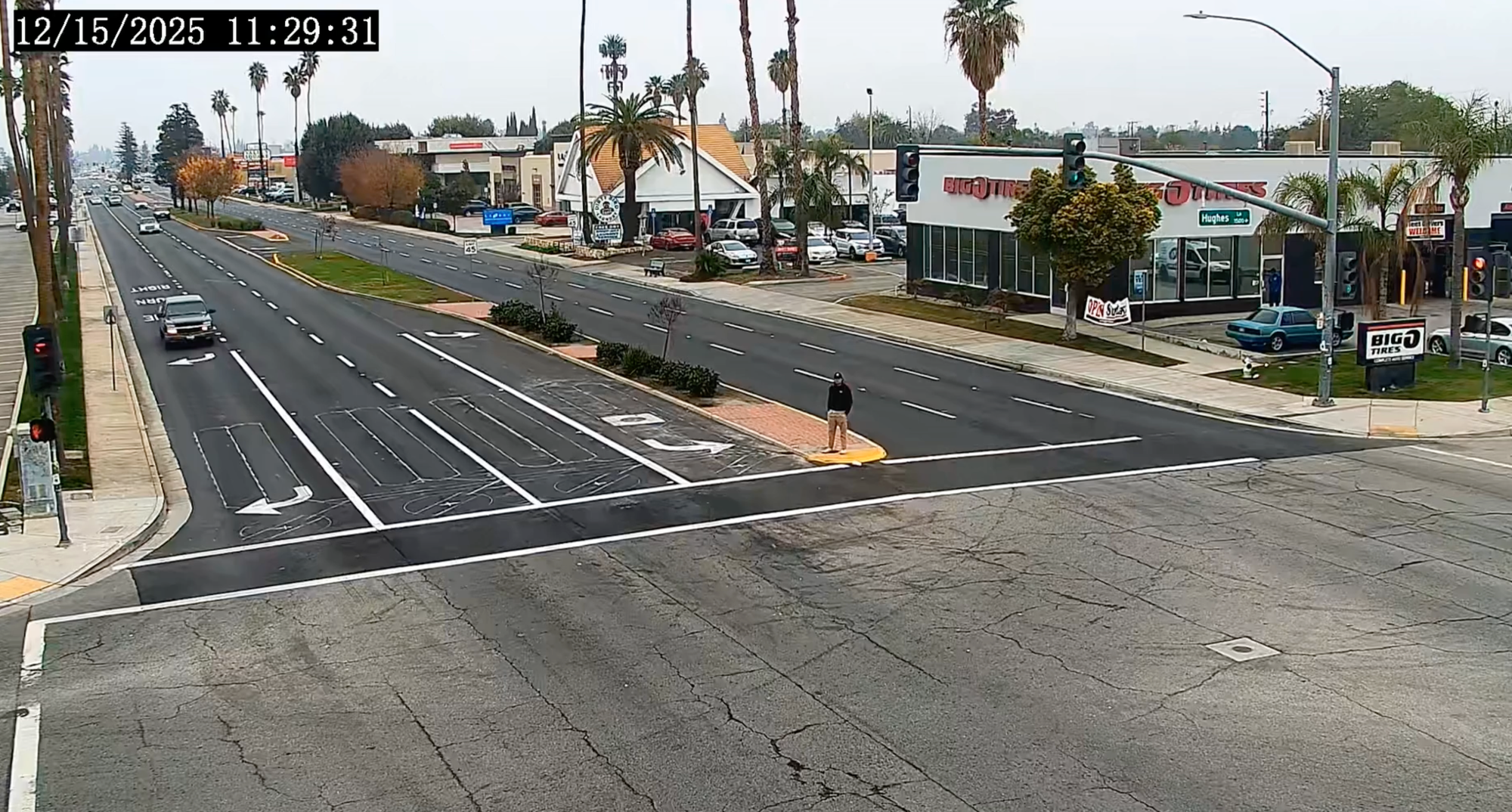
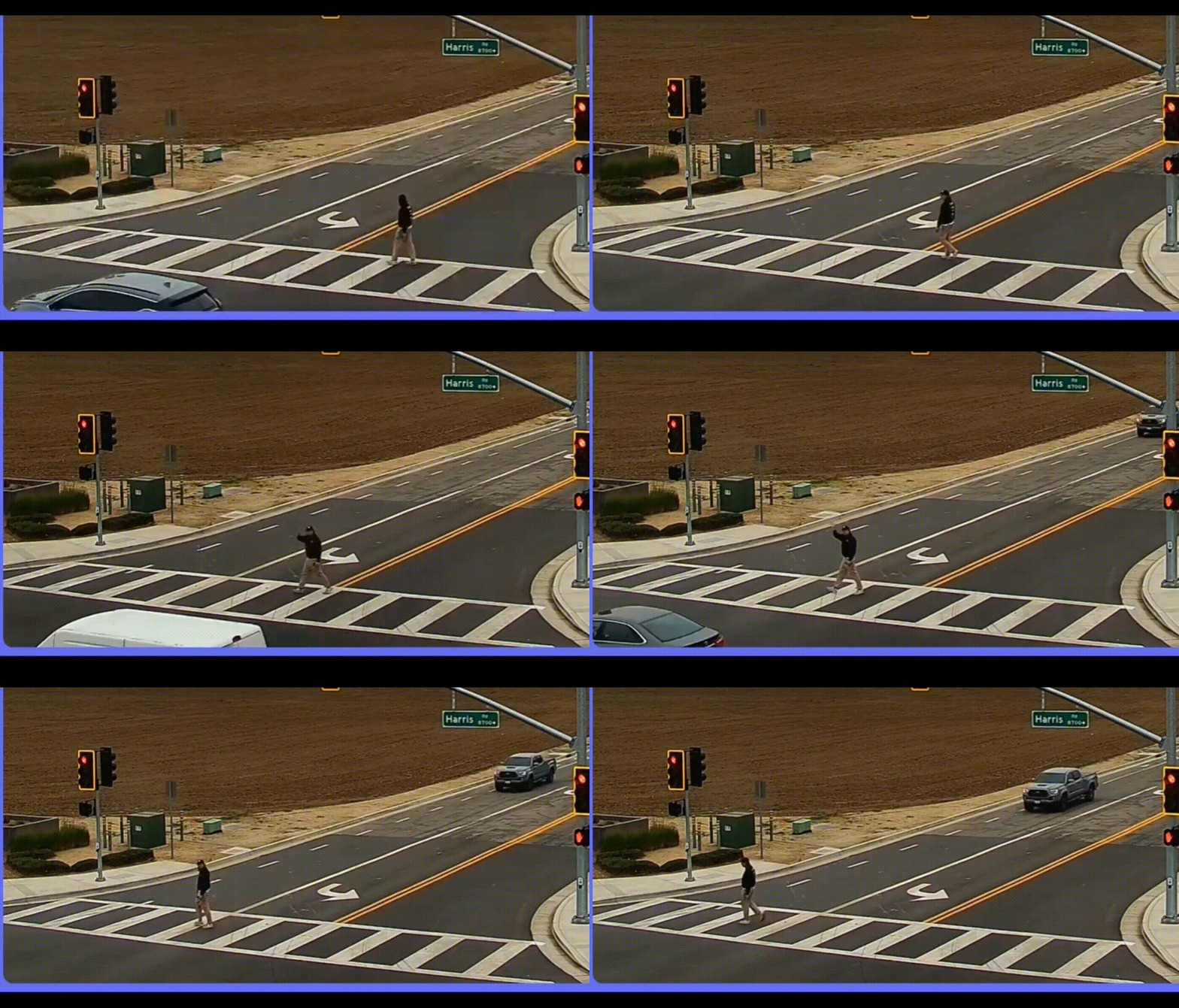
I am standing on the corner of Harris Road and Young Street outside of the Crossroads Business Park in Bakersfield, California, looking up at a Flock surveillance camera bolted high above a traffic signal. On my phone, I am watching myself in real time as the camera records and livestreams me—without any password or login—to the open internet. I wander into the intersection, stare at the camera and wave. On the livestream, I can see myself clearly. Hundreds of miles away, my colleagues are remotely watching me too through the exposed feed.
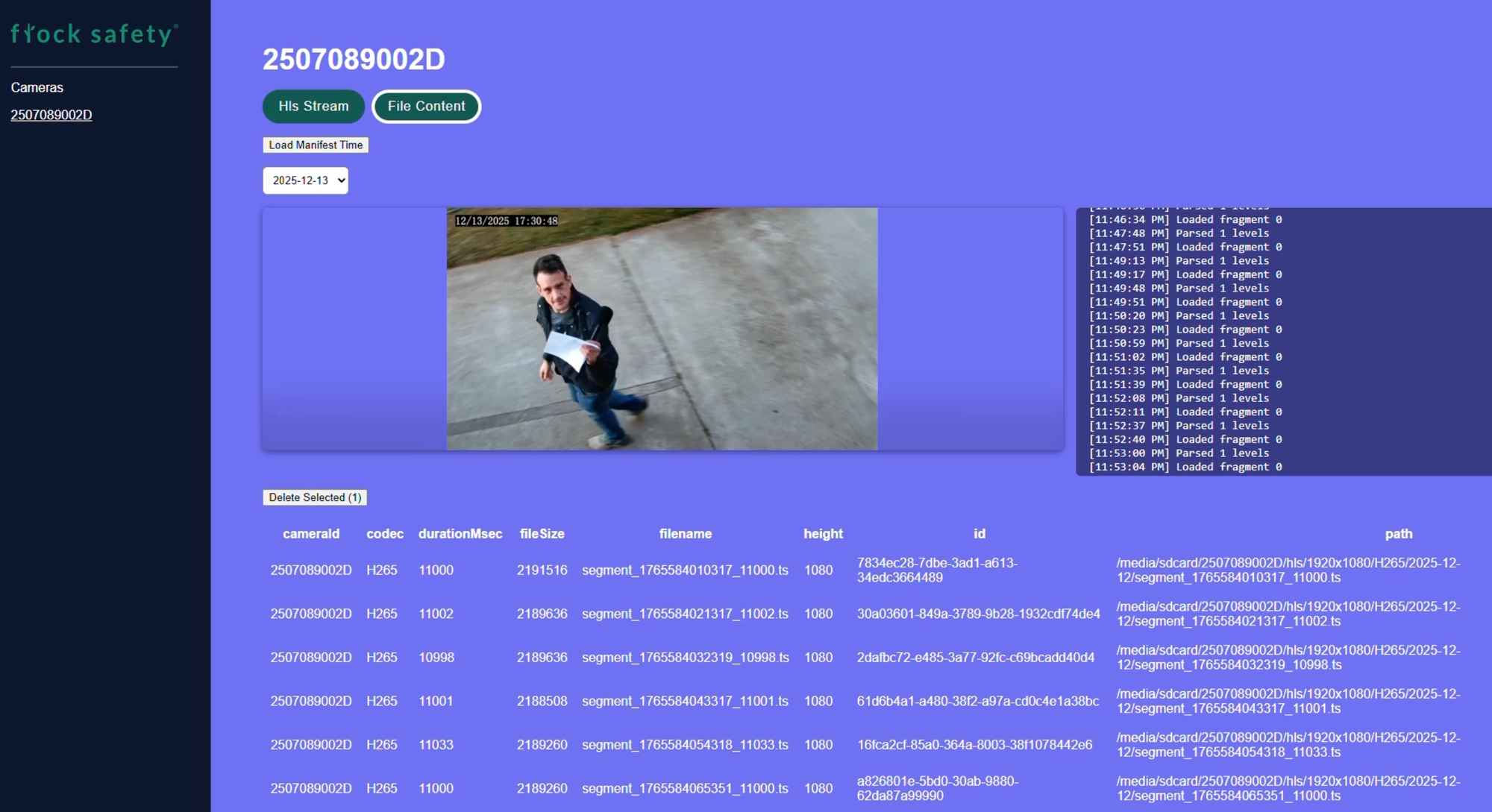
Flock left livestreams and administrator control panels for at least 60 of its AI-enabled Condor cameras around the country exposed to the open internet, where anyone could watch them, download 30 days worth of video archive, and change settings, see log files, and run diagnostics.
Unlike many of Flock’s cameras, which are designed to capture license plates as people drive by, Flock’s Condor cameras are pan-tilt-zoom (PTZ) cameras designed to record and track people, not vehicles. Condor cameras can be set to automatically zoom in on people’s faces as they walk through a parking lot, down a public street, or play on a playground, or they can be controlled manually, according to marketing material on Flock’s website. We watched Condor cameras zoom in on a woman walking her dog on a bike path in suburban Atlanta; a camera followed a man walking through a Macy’s parking lot in Bakersfield; surveil children swinging on a swingset at a playground; and film high-res video of people sitting at a stoplight in traffic. In one case, we were able to watch a man rollerblade down Brookhaven, Georgia’s Peachtree Creek Greenway bike path. The Flock camera zoomed in on him and tracked him as he rolled past. Minutes later, he showed up on another exposed camera livestream further down the bike path. The camera’s resolution was good enough that we were able to see that, when he stopped beneath one of the cameras, he was watching rollerblading videos on his phone.
0:00
/0:16
The exposure was initially discovered by YouTuber and technologist Benn Jordan and was shared with security researcher Jon “GainSec” Gaines, who recently found numerous vulnerabilities in several other models of Flock’s automated license plate reader (ALPR) cameras. They shared the details of what they found with me, and I verified many of the details seen in the exposed portals by driving to Bakersfield to walk in front of two cameras there while I watched myself on the livestream. I also pulled Flock’s contracts with cities for Condor cameras, pulled details from company presentations about the technology, and geolocated a handful of the cameras to cities and towns across the United States. Jordan also filmed himself in front of several of the cameras on the Peachtree Creek Greenway bike path. Jordan said he and Gaines discovered many of the exposed cameras with Shodan, an internet of things search engine that researchers regularly use to identify improperly secured devices.
After finding links to the feed, “immediately, we were just without any username, without any password, we were just seeing everything from playgrounds to parking lots with people, Christmas shopping and unloading their stuff into cars,” Jordan told me in an interview. “I think it was like the first time that I actually got like immediately scared … I think the one that affected me most was as playground. You could see unattended kids, and that’s something I want people to know about so they can understand how dangerous this is.” In a YouTube video about his research, Jordan said he was able to use footage pulled from the exposed feed to identify specific people using open source investigation tools in order to show how trivially an exposure like this could be abused.
Benn Jordan
Last year, Flock introduced AI features to Condor cameras that automatically zoom in on people as they walk by. In Flock’s announcement of this feature, it explained that this technology “zooms in on a suspect exiting one car, stealing an item from another, and returning to his vehicle. Every detail is captured, providing invaluable evidence for investigators.” On several of the exposed feeds, we saw Flock cameras repeatedly zooming in on and tracking random people as they walked by. The cameras can be controlled by AI or manually.
The exposure highlights the fact that Flock is not just surveilling cars—it is surveilling people, and in some cases it is doing so in an insecure way, and highlight the types of places that its Condor cameras are being deployed. Condor cameras are part of Flock’s ever-expanding quest to “prevent crime,” and are sometimes integrated with its license plate cameras, its gunshot detection microphones, and its automated camera drones.
Cooper Quintin, senior staff technologist at the Electronic Frontier Foundation, told me the behavior he saw in videos we shared with him “shows that Flock's ambitions go far beyond license-plate surveillance. They want to be a nation-wide panopticon, watching everyone all the time. Flock's goal isn't to catch stolen cars, their goal is to have total surveillance of everyone all the time."
0:00
/1:03
The cameras were left not just livestreaming to the internet for anyone who could find the link, but in many cases their administrative portals were left open with no login credentials required whatsoever. On this portal, some camera settings could be changed, diagnostics could be run, and text logs of what the camera was doing were being streamed, too. Thirty days of the camera’s archive was left available for anyone to watch or download from any of the cameras that we found. We were not able to geolocate every camera that was left unprotected, but we found cameras at a New York City Department of Transportation parking lot, on a street corner in suburban New Orleans, in random cul-de-sacs, in a Lowes parking lot, in the parking lot of a skatepark, at a pool, outside a parking garage, at an apartment complex, outside a church, on a bike path, and at various street intersections around the country. 404 Media did not change any settings on any cameras and only viewed footage.
“This is not the first time we have seen ALPRs exposed on the public internet, and it won't be the last. Law enforcement agencies around the country have been all too eager to adopt mass surveillance technologies, but sometimes they have put little effort into ensuring the systems are secure and the sensitive data they collect on everyday people is protected,” Quintin said. “Law enforcement should not collect information they can’t protect. Surveillance technology without adequate security measures puts everyone’s safety at risk.”
It was not always clear which business or agency owned specific cameras that were left exposed, or what type of misconfiguration led to the exposure, though I was able to find a $348,000 Flock contract for Brookhaven, Georgia, which manages the Peachtree Creek Greenway, and includes 64 Condor cameras.
"This was a limited misconfiguration on a very small number of devices, and it has since been remedied," a Flock spokesperson told 404 Media. It did not answer questions about what caused the misconfiguration or how many devices ultimately were affected.
In response to Jordan and Gaines’ earlier research on vulnerabilities in other Flock cameras, Flock CEO Garrett Langley said in a LinkedIn post that “The Flock system has not been hacked. We secure customer data to the highest standard of industry requirements, including strict industry standard encryption. Flock’s cloud storage has never been compromised.” The exposure of these video feeds is not a hack of Flock’s system, but demonstrates a major misconfiguration of at least some cameras. It also highlights a major misconfiguration in its security that persisted for at least days.
“When I was making my last video [about Flock ALPR vulnerabilities], it was almost like a catchphrase where I'd say like, ‘I don't see how it could get any worse.’ And then something would happen where you'd be like, wow, they pulled it off. They made it worse,” Jordan said. “And then this is like the ultimate one. Because this is completely unrelated [to my earlier research] and I don’t really know how it could be any worse to be honest.”
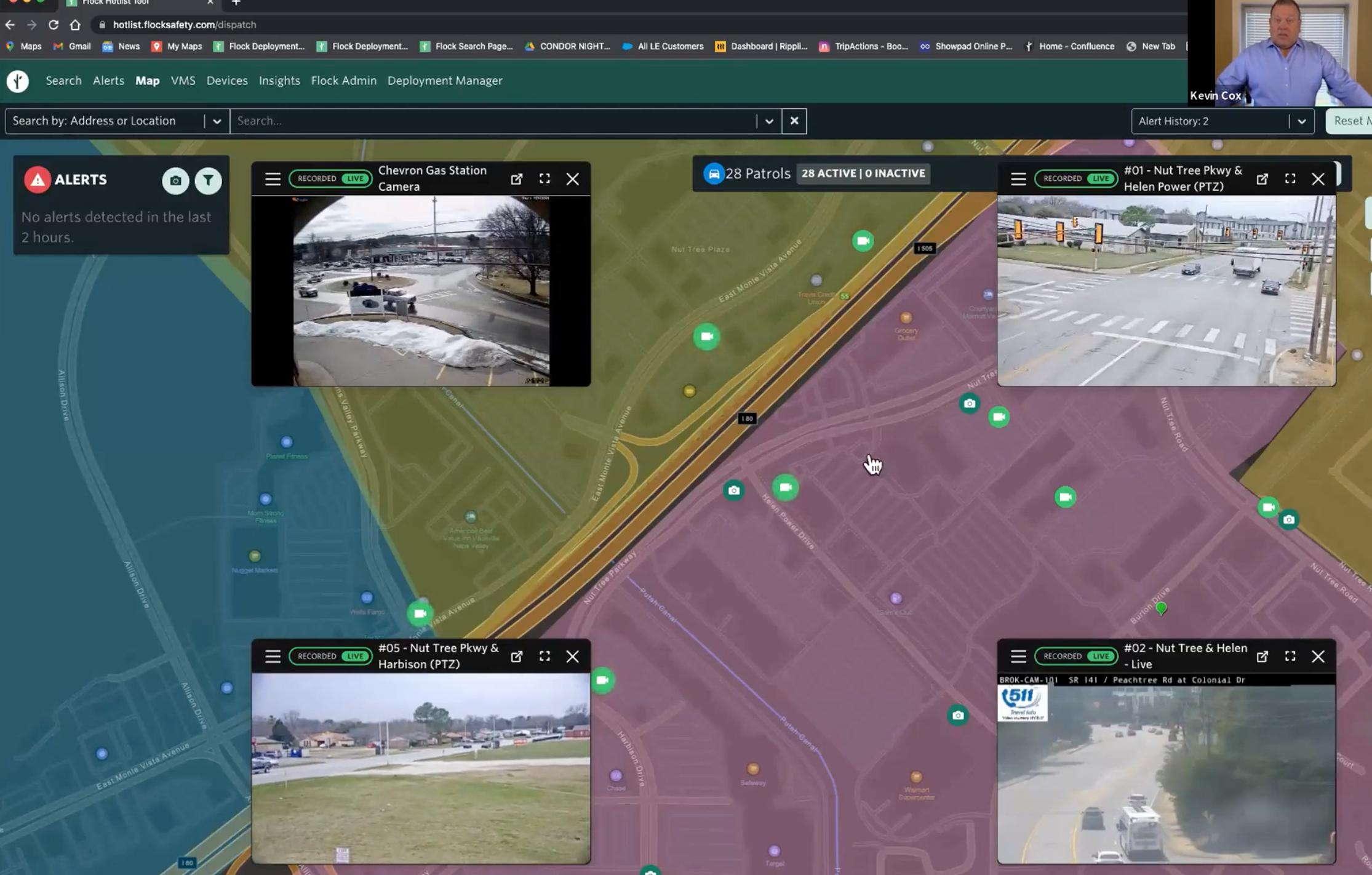
In a 2023 video webinar introducing the Condor platform to police, Flock executives said the cameras are meant to be paired with their ALPR cameras and are designed to feed video to FlockOS, a police panel that allows cops to hop from camera to camera in real time across a mapped-out view of their city. In Bakersfield, which has 382 Flock cameras according to a transparency report, one of the Condor cameras we saw was located next to a mall that had at least two Flock ALPR cameras stationed at the entrances to the mall parking lot.
Kevin Cox, a Flock consultant who used to work for the Grand Prairie, Texas Police Department, said in the webinar that he built an “intel center” with a high “density” of Flock cameras in that city. “I am passionate about this because I’ve lived it. The background behind video [Condor] with LPR is rich with arrests,” he said. “That rich experience of seeing what happened kind of brings it alive to [judges]. So video combined with the LPR evidence of placing a vehicle at the scene or nearby is an incredibly game changing experience into the prosecutorial chain of events.”
“You can look down a tremendous distance with our cameras, to the next intersection and the next intersection,” he said. “The camera will identify people, what they’re wearing, and cars up to a half a mile away. It’s that good.”
0:00
/0:08
Condor cameras in a Flock demo showing off its AI tracking features
In the webinar Cox pulled up a multiview panel of a series of cameras and took control of them, dragging, panning, and zooming on cameras and hopping between multiple cameras in real time. Cox suggested that police officers could either use Flock’s cameras to pinpoint a person at a place and time and then use it to request “cell tower dumps” from wireless companies, or could use cell GPS data to then go into the Flock system to track a person as they moved throughout a city. “If you can place that person’s cell phone and then the Condor video and Falcon LPR evidence, it would be next to impossible to beat that in court,” he said, adding that some towns may just want to have always-on, always recording video of certain intersections or town squares. “There’s endless endless uses to what we can do with these things.”
On the webinar, Seth Cimino, who was a police officer at the Citrus Heights, California police department at the time but now works directly for Flock, told participants that officers in his city enjoyed using the cameras to zoom in on crimes.
“There is an eagerness amongst our staff that are logged in that have their own Flock accounts to be able to monitor our ALPR and pan tilt zoom Condor cameras throughout the community, to a point where sometimes our officers are beating dispatch with the information,” he said. “If there’s an incident that occurs at a specific intersection or a short distance away where our Condor cameras can zoom in on that area, it allows for real time overwatch […] as I sit here right now with you—how cool is this? We just had a Flock alert here in the city. I mean, it just popped up on my screen!”
Nearly the entire legal and economic policy staff of the Heritage Foundation is departing the conservative think tank, and many will be taking up posts at Advancing American Freedom (AAF), a nonprofit founded in 2021 by former Vice President Mike Pence. The mass exodus represents a dramatic rebuke of Heritage President Kevin Roberts in the wake of his refusal to retract an October video defending Tucker Carlson for conducting a friendly interview with the antisemitic influencer Nick Fuentes.
"Why these people are coming our way is that Heritage and some other voices and commentators have embraced big-government populism and have been willing to tolerate antisemitism," Pence toldThe Wall Street Journal.
More than 30 employees at the Heritage Foundation's Institute for Constitutional Government, Ed Meese Center for Legal and Judicial Studies, Center for Data Analysis, Thomas A. Roe Institute for Economic Policy Studies, and Grover M. Hermann Center for the Federal Budget have resigned or were fired in the last few days. Those departing include Amy Swearer, who told Roberts he had lost her confidence as a leader during an all-staff meeting in November that leaked to the press, and John Malcolm, a Heritage vice president and the foundation's top legal scholar, who was fired last Thursday after Roberts caught wind of the plan to leave for AAF, according to multiple sources. E.J. Antoni—who was briefly President Donald Trump's nominee for Commissioner of Labor Statistics—is staying on and will serve as acting director of several of the aforementioned teams.
The departures follow resignations by three Heritage Foundation trustees: Princeton professor Robby George, businessman Shane McCullar, and philanthropist Abby Spencer Moffat. Sources say Moffat, who serves as president and CEO of the Diana Davis Spencer Foundation, has also withdrawn millions of dollars in funding from Heritage—and that she's not the only one. (Some of that money may have been redirected to Pence's group; "AAF said it was able to raise more than $10 million in a few weeks to make the new hires," the Journal reports.) And last month an antisemitism task force cut ties with the think tank.
Over at The Volokh Conspiracy, Josh Blackman shares a letter he wrote to Roberts explaining his decision to step down as senior editor of the latest edition of The Heritage Guide to the Constitution. "Your actions have made my continued affiliation with Heritage untenable," Blackman writes. "First, your comments were a huge unforced blunder, and gave aid and comfort to the rising tide of antisemitism on the right. Second, in the wake of your remarks, jurists, scholars, and advocates have made clear to me they can no longer associate with the Heritage Guide they contributed to. Third, and perhaps most tragically, your actions have weakened the ability of the storied Meese Center for Legal and Judicial Studies to promote the rule of law. My resignation is effective immediately."
The personnel changes are the latest of many recent incidents that together show serious instability on what is often called the New Right. Other examples include reformicon wonks like Henry Olsen and Oren Cass publishing blistering critiques of Roberts' judgment as a leader and Ben Shapiro unloading on Carlson, Fuentes, Megyn Kelly, and Candace Owens at last week's Turning Point USA confab.
The conservative movement has undergone something of a sea change over the last 12 months. Heading into 2025, the conventional wisdom was that the New Right and its muscular, grievance-fueled political approach were the GOP's future. A jubilant atmosphere surrounding Trump's second inauguration did little to foreshadow the cracks that have since broken open (although those with ears to hear were noticing tremors a year ago involving the Tech Right–New Right divide).
Today, the divisions on the right are not just between pro-Trump and anti-Trump conservatives (or pro-Trump conservatives and never-Trump former conservatives). There is now a schism within the MAGA coalition over how big the tent should be and what exactly it should stand for.
One of the key sources of disagreement has to do with whether "legacy" or "heritage" Americans—those who can trace their bloodlines to the land for many generations—have more of a claim to belonging and status than do relative newcomers and others without an Anglo-Protestant pedigree. Carlson and Fuentes have both pushed versions of that line, as have large numbers of "very online" young conservatives, particularly in recent weeks.
But not everyone on the right is comfortable with such notions. Last month, while accepting an award at the American Enterprise Institute's annual gala, the Revolutionary War–era historian Gordon Wood pointedly rejected the idea that American nationhood is rooted in blood, soil, religion, or race. More recently, both Ben Shapiro ("we are, in fact, a creedal country, and there is no other definition of Americanism that tends to hold historical water") and Vivek Ramaswamy ("you are an American if you believe in the rule of law, in freedom of conscience and freedom of expression, in colorblind meritocracy, in the U.S. Constitution, in the American dream, and if you are a citizen who swears exclusive allegiance to our nation") have echoed the same theme.
Although some of the emerging critics of Carlson's wing of the movement support deregulation and free trade, this is not merely an ideological proxy battle over the role that libertarian economics should play in the Post-Trump GOP. Ramaswamy's op-ed calls for the creation of a new multibillion-dollar entitlement, while Cass has made his bones imploring Republicans to reject what he derisively calls "market fundamentalism." Yet both men have broken with many erstwhile MAGA allies over the movement's identitarian turn.
After Carlson interviewed Fuentes in October, Bulwark journalist Will Sommer wrote that the American right "has no immune system against hatemongers and grifters." But that no longer seems correct. The immune response over the last two months has been ferocious.
It may not be enough to overcome the Black Death of bigotry and conspiracism that has festered in the conservative movement for the better part of the last decade. And it's fair to note the many ways in which figures like Shapiro (who chose to employ Owens at The Daily Wiredespite her long history of disturbing comments) and Ramaswamy helped create the problems they're now decrying. But it's a relief to know there are, in the end, limits to what a prominent swath of the conservative movement will stand for.
"Heritage has always welcomed debate, but alignment on mission and loyalty to the institution are non-negotiable," reads an emailed statement from the think tank, the full text of which was published this morning at National Review. Unfortunately for Roberts—but perhaps fortunately for the health of American politics—many of his own people seem to feel a loyalty to something higher than the ideas and ethos with which he has aligned that institution.
 Log in